Categories
Blog

Building a Robust Power Plant Maintenance Blueprint

To create a robust maintenance blueprint, we need to identify the maintenance philosophy, maintenance types and workflows, create master plans and maintenance schedule matrices. Additionally, finalizing a condition monitoring system and a critical equipment maintenance strategy are essential.

A solid CMMS platform aims to achieve a planned maintenance activity of nearly 98%. Documentation is crucial in any maintenance activity. The ability of CMMS software to retrieve past maintenance history, failure frequency, and repair times offers insights into past equipment performance and identifies areas where changes are necessary to ensure 100% equipment availability.

Moreover, proper safety training, performance tracking with KPI indicators, a strong audit and review mechanism, and a continuous improvement loop will aid in establishing robust maintenance practices.

Let’s dive into each of the above in detail.

1. Maintenance Philosophy

The main goal is to ensure maximum availability of the equipment, safe operations, regulatory compliance, and minimized lifecycle costs.

Strategies to Include:

  • Preventive Maintenance (PM)
  • Condition-Based Maintenance (CBM)
  • Reliability-Centered Maintenance (RCM)
  • Shutdown/Outage-Based Maintenance
  • Risk-Based Maintenance (RBM)

2. Maintenance Types & Workflows

TypeFocusTools/Methods
Preventive (PM)Scheduled based on time or usageTime-based schedules, OEM guidelines
Predictive (PdM)Condition monitoring for early fault detectionVibration analysis, thermography, oil analysis
Corrective (CM)Repairs after failure or defect detectionRoot cause analysis, breakdown response
ShutdownDeep inspections and overhauls during planned outagesTurnaround planning, Gantt-based execution

3. Maintenance Master Plan

A. Asset Register

Each asset should be tagged with:

  • Asset ID
  • Location
  • OEM
  • Service interval
  • Criticality rating

B. Maintenance Schedule Matrix

EquipmentFrequencyMaintenance TypeTools UsedResponsible Team
BoilerMonthlyPreventiveBorescope, NDTMechanical Team
TurbineQuarterlyPredictiveVibration AnalyzerOEM/CBM Experts
GeneratorHalf-YearlyPreventiveIR Tester, DGAElectrical Team
Cooling TowersMonthlyPreventiveManual, CMMSUtility Team

4. Condition Monitoring System (Online & Offline)

Key parameters to monitor:

  • Vibration (Turbines, Motors)
  • Temperature (Bearings, Transformers)
  • Pressure (Boilers, Compressors)
  • Oil quality (Turbines, Gears)
  • Partial Discharge (Generators)

Tools like SKF/CMS systems, FLIR cameras, SCADA, and IoT sensors are ideal for monitoring.

5. Critical Equipment Strategy

Prioritize:

  • Boilers, Turbines, Generators, Transformers, HT Motors, ESPs

Action Plan:

  • Develop Failure Mode & Effects Analysis (FMEA)
  • Maintain spare parts inventory
  • Assign condition-based maintenance triggers
  • Establish OEM liaison for critical failures

6. Documentation & CMMS IntegrationUsing a CMMS (like SAP PM, Maximo, or Trons):

  • Schedule and log all maintenance activities
  • Track KPIs (MTBF, MTTR, downtime, cost/asset)
  • Manage spares and inventory
  • Trigger auto-notifications for maintenance due

7. Safety, Regulatory & Training

Compliance:

  • ISO 55000 (Asset Management)
  • ISO 45001 (Occupational Health & Safety)
  • Boiler & Factory Act Compliance

Training:

  • Standard Operating Procedures (SOPs) and skill matrix for all technicians
  • Annual HIRA refreshers
  • Mock drills for critical failure scenarios

8. KPIs and Performance Tracking

MetricGoal
Equipment Availability> 95%
MTTR (Mean Time to Repair)Reduce year-over-year
PM Completion Rate> 98%
PdM Accuracy> 85% fault prediction
Downtime HoursTarget < planned

9. Audit & Review Mechanism

  • Quarterly maintenance reviews
  • Yearly third-party health audits
  • Digital dashboards for real-time alerts and metrics
  • Root Cause Analysis (RCA) after major breakdowns

10. Continuous Improvement Loop

  • Capture feedback after every shutdown
  • Analyze trends using CMMS data
  • Revise maintenance frequency as per performance
  • Leverage AI/ML (if feasible) for failure prediction
Categories
Blog

Overcoming Refractory Challenges and Optimizing Operations in CFBC Boilers

As the demand for efficient and sustainable energy solutions grows, boilers using Indian coal face unique refractory challenges that can impact their performance and longevity. In this blog, we will explore the major refractory issues encountered in these boilers, effective methods to control clinker formation in Circulating Fluidized Bed Combustion (CFBC) boilers, and key operational philosophies for operating the stripper cooler.

1. Major Refractory Challenges in Boilers Using Indian Coal

Boilers firing Indian coal often experience several refractory challenges due to the unique characteristics of the coal. Let’s dive into the main issues:

High Ash Content (25–45%)

  • Impact: Excessive slag formation in the furnace.
  • Challenge: Slag adheres to and chemically reacts with refractories, causing erosion and corrosion, especially in furnace walls, burner tiles, and slagging zones.

Low Ash Fusion Temperature

  • Impact: Causes early slag melting at boiler operating temperatures.
  • Challenge: Molten slag can attack the refractory lining, particularly in secondary combustion zones.

Alkali and Sulphur Compounds

  • Impact: Presence of sodium, potassium, and sulphur compounds in ash.
  • Challenge: These compounds react with silica/alumina refractories, causing chemical degradation and spalling, especially in superheater and economizer zones.

High Abrasiveness

  • Impact: Mineral particles in coal ash are sharp and hard.
  • Challenge: These particles cause mechanical wear of refractories in cyclones, ducts, and ash hoppers.

Thermal Shock Due to Load Fluctuations

  • Impact: Frequent start-stop cycles due to variable coal quality and grid demands.
  • Challenge: Causes cracking and delamination of refractory linings, especially in burner throats and boiler front walls.

Poor Ash Handling

  • Impact: Accumulated ash can lead to localized overheating.
  • Challenge: Promotes hotspot formation, which accelerates localized refractory failure.
Mitigation Strategies:
  • Use high alumina, silicon carbide, or chrome-containing refractories for slag-resistant zones.
  • Install expansion joints and use insulating layers to manage thermal stress.
  • Perform regular inspections and maintenance for early detection of wear.

2. Effective Methods to Control Clinker Formation in CFBC Boilers

Clinker formation inside the loop seal of a CFBC boiler can disrupt ash recirculation and boiler efficiency. Here’s how to control it:

1. Maintain Proper Loop Seal Temperature

  • Cause: High temperatures cause ash to partially melt and form clinkers.
  • Control: Keep the loop seal temperature below 850°C, depending on the ash fusion temperature of the fuel. Use temperature sensors and cooling air or fluidized bed cooling if needed.

2. Ensure Adequate Fluidization

  • Cause: Inadequate fluidization leads to dead zones where ash settles and sinters.
  • Control:
    • Ensure uniform and sufficient airflow through loop seal nozzles.
    • Prevent nozzle blockages and monitor air pressure and flow balance.

3. Use of Inert Material/Sand Addition

  • Benefit: Helps maintain fluidized bed activity and dilutes ash stickiness.
  • Control: Periodically add coarse inert material (like sand or coarse ash) to prevent clinker formation.

4. Control Bed Inventory and Ash Recirculation Rate

  • Cause: Overloading the loop seal with hot ash increases sintering risk.
  • Control: Monitor and maintain optimal bed height, loop seal level, and ash return flow.

5. Avoid High Sulphur and High Alkali Fuels Without Additives

  • Cause: These fuels promote sticky ash and low-temperature slag formation.
  • Control: Use additives like limestone or dolomite to neutralize sulphur and prevent ash sintering.

6. Regular Mechanical Cleaning/Flushing

  • Control: If clinkering persists, schedule offline flushing or rodding of loop seal internals to remove the build-up.

7. Design Considerations

  • Ensure the loop seal design allows for uniform fluid distribution, easy access, and provisions for ash cooling.

3. Operational Philosophies for Operating the Stripper Cooler in CFBC Boilers

The stripper cooler plays a crucial role in CFBC boilers by cooling and regulating the recirculating hot bed material. Efficient operation of this component is vital for combustion stability, ash handling, and preventing clinker formation. Here are the key operational philosophies:

1. Maintain Stable Fluidization

  • Objective: Ensure uniform mixing and prevent hot spots or channeling.
  • Action: Provide consistent and balanced fluidizing air and prevent nozzle choking.

2. Control Bed Temperature

  • Objective: Prevent ash melting and clinker formation.
  • Action: Maintain bed temperature between 800–850°C, below the ash fusion point. Use cooling air and adjust ash withdrawal rate.

3. Avoid Full Emptying of Stripper Cooler

  • Why: Completely emptying the stripper cooler leads to sudden inflow of high-temperature ash, which can burn independently and cause overheating and clinkerization.
  • Action: Always maintain a minimum bed level for controlled heat dissipation and mixing.

4. Control Inflow of Hot Ash via Mobilizing Line

  • Why: Unchecked inflow from the mobilizing line causes temperature spikes inside the stripper section.
  • Action: Throttle the mobilizing line or control its valve to regulate the rate of ash entry and maintain stable temperatures.

5. Optimize Heat Recovery

  • Objective: Maximize sensible heat recovery from solids.
  • Action: Maintain clean cooling surfaces in water-cooled strippers and prevent ash build-up to improve heat exchange efficiency.

6. Monitor Differential Pressure

  • Objective: Early detection of choking or fluidization issues.
  • Action: Regularly track differential pressure trends and investigate any abnormal fluctuations.

7. Regulate Solids Recirculation

  • Objective: Avoid clogging and uneven ash return.
  • Action: Ensure consistent ash flow through loop seals and the stripper. Maintain even solids loading to prevent dead zones.

8. Gradual Start-up and Shutdown

  • Objective: Avoid thermal shocks and clinker formation.
  • Action: Gradually increase temperature and airflow during start-up and maintain fluidizing air until the bed cools down sufficiently during shutdown.

9. Prevent Overloading

  • Objective: Avoid excessive bed height and internal pressure buildup.
  • Action: Operate within design bed inventory limits and prevent dumping excessive hot ash.

10. Visual and Ash Quality Checks

  • Objective: Identify early signs of clinker formation.
  • Action: Periodically check ash discharge quality for signs of lumps or sintering.

4. Reducing Unburnt Carbon in Bottom Ash of AFBC Boilers

Reducing combustibles in the bottom ash of an underfeed-type AFBC boiler is critical for improving combustion efficiency and reducing fuel loss. Here’s how you can achieve it:

1. Improve Fuel Fineness

  • Why: Coarse particles leave unburnt carbon.
  • Action: Ensure proper coal grinding (target 90% passing through 200 mesh if feasible) and avoid oversized fuel particles.

2. Optimize Bed Temperature

  • Why: Low bed temperatures lead to incomplete combustion.
  • Action: Maintain bed temperature between 800–850°C, depending on coal type. Monitor temperature uniformity with thermocouples at multiple bed locations.

3. Ensure Uniform Air Distribution

  • Why: Poor fluidization leads to unburnt coal pockets.
  • Action: Balance primary airflow and inspect air nozzles regularly to avoid blockage.

4. Improve Fuel and Bed Material Mixing

  • Why: Poor mixing results in localized burning and fuel escape.
  • Action: Maintain adequate bed height and proper bed material size (1–3 mm). Consider replacing part of the bed material periodically.

5. Regulate Fuel Feed Rate

  • Why: Excessive fuel feed overwhelms combustion capacity.
  • Action: Synchronize fuel feed with air supply and adjust based on oxygen sensor feedback.

6. Secondary Air Injection (if available)

  • Why: Enhances burnout of volatiles and fine particles.
  • Action: Inject secondary air above the bed level and adjust based on CO and O₂ readings.

7. Monitor and Optimize O₂ and CO Levels in Flue Gas

  • Why: High CO or low O₂ indicates incomplete combustion.
  • Action: Keep O₂ levels between 3–6% and CO below 100 ppm. Adjust the air-fuel ratio as needed.

8. Regular Ash Sampling and Analysis

  • Why: Helps track combustion trends.
  • Action: Perform Loss on Ignition (LOI) tests on bottom ash regularly and fine-tune operational settings based on results.

Conclusion

Addressing the refractory challenges associated with Indian coal and implementing effective operational strategies in CFBC boilers is crucial for optimizing performance. By controlling clinker formation and ensuring the proper operation of components like the stripper cooler, boiler operators can enhance efficiency, reduce maintenance costs, and extend equipment lifespan. Continuous monitoring and strategic adjustments will ultimately lead to safer and more reliable boiler operations.

Categories
Blog

TUBE FAILURES & TESTING EQUIPMENT

•TOPIC COVERS IN TUBE FAILURES AND TESTING

•VARIOUS INSPECTION TESTS, INCLUDING THE LATEST EQUIPMENT

•HOW TO HANDLE A PRESSURE PART FAILURE

•VARIOUS TYPES OF TUBES FAILURES, CAUSES & REMEDIES

Methods for inspection

  • Visual inspection                          
  • Thickness measurement               
  • DPT/MPT/UT   
  • NDT Test Selection      
  • Modern testing equipment  

TYPES OF TESTINGS FOR TUBE FAILURES

TESTING CLASSIFICATION

MOST POWERFUL INSPECTION TOOL

THUS VISUAL INSPECTION IS THE MASTER OF ALL TESTING

•DESTRUCTIVE

–TENSILE TEST

–COMPRESSION TEST

–BEND TEST

–IMPACT TEST

–MICRO/MACRO ANALYSIS

•NON-DESTRUCTIVE

–RADIOGRAPHY

–ULTRASONIC TESTING

–MAGNETIC PARTICLE TESTING

–DYE PENETRANT TESTING

–ELECTROMAGNETIC TESTING

–LEAK TESTING

–VISUAL TESTING

–RFID

–LFET

–IRIS

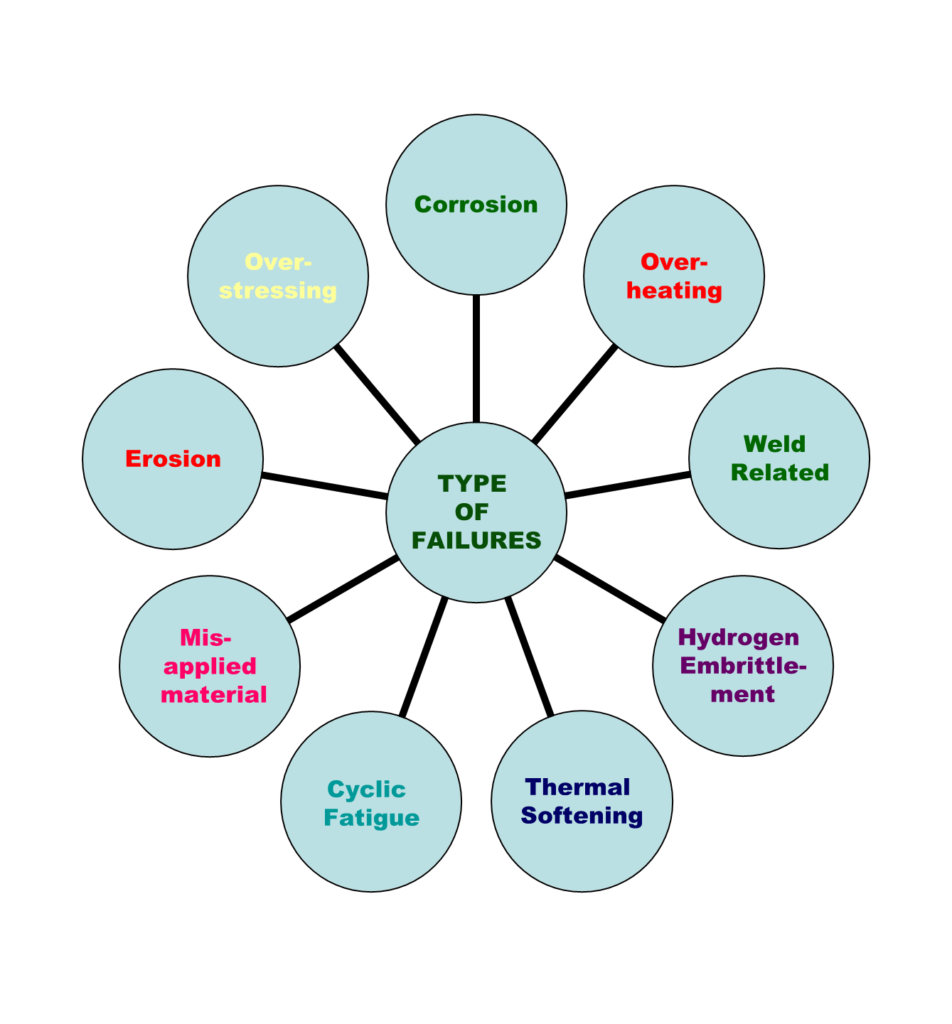
Types of tube failures

types of failure in tube

WHY PRE-HEATING OF BASE METAL?

• Pre-heat removes moisture content from base metal which can lead to poor welding quality.

•Distortion of base metal due to internal stresses developed during welding.

•Reduces hardness of weld metal 

•Control cooling rate to avoid cracking 

WHY BAKE LOW HYDROGEN ELECTRODES?

•Visible external porosity in addition to internal porosity.

•Moisture can cause slag removal difficult, a rough weld surface and cracking  

WHY CALIBRATION?

calibration

•To ensure proper working of instrument/equipment 

•Improper working of the baking oven can result in over/ under heating of the electrode 

•Improper working of welding equipment can lead to wrong operation characteristics of m/c resulting in welding defects

•Improper working of measuring instrument can lead to failure during assembly

FIBEROSCOPY/ VIDEOS COPY

Components  – 

Accessible internal surface of Tubes & Header

Visual inspection – Photographs of the inspected object taken

Fiberscope carried out where :

-Specimen may not be removed

 because it would weaken or 

 otherwise, render it useless for

 service.

-Part or structure too large to 

 bring to laboratory

-Object inaccessible

OXIDE SCALE MEASUREMENT

•Tube Temperatures > 900o F

•Failure prone to Creep Fatigue

•Oxide Scale formed (Fe2O3)

•Metal temperature increase 1-2o F increases creep damage

INSITU METALLOGRAPHY

Field surface Replication is a process that permits obtaining an image of a component surface with sufficient retention of fine structure to allow laboratory examination & evaluation without having to cut out a portion of the component. The assessment of grain size and precipitate spacing using both optical & electron microscopy can establish the presence of microstructural damage or changes and assist in understanding service conditions.

HOW TO HANDLE PRESSURE PARTS FAILURE

•Consider Pressure Parts failure as a serious lapse from either designer, erector, commissioning engineer or O & M staff.

•Treat it as a crime, and FIR must be logged with utmost care.

•Shut the unit as early as possible to minimize further damage.

•Gather as much as information possible related to failure, that includes data before failure, at the time of failure and after the failure 

•Preserve the operating log sheet and DCS trends as early as possible

•Spend a minimum of 15-30 minutes inspecting & investigating the failure area without disturbing the evidence.

•Take a Photograph of the failed and surrounding area along with noting critical observation.

•Inspect the adjacent tube condition with the same zeal & attitude.

•Type of failure would more often suggest the cause.

•Cut down the failed tube of @ 500 mm length, keeping failed spot at the centre. Cut the tube preferably with a hack saw.

•Before cutting the sample, mark tube no., the direction of fluid flow, side facing flue gas flow

•Do not remove the internal deposit of the cut tube and cover both ends of the cut tube. 

•Try to preserve the external deposit too.

•If overheating symptoms are there, it is advisable to cut one more sample from the adjacent un-failed tube.

•Send the tube sample to IJT H.O with proper packing along with the Data format filled.

•Carry out thorough Physical, chemical and metallurgical analysis of both tubes.

•Carry out deposit analysis collected from failed tubes. Which will indicate the water chemistry condition.

•Based on the analysis, the root cause can be concluded.

•Ensure that all the corrective actions on the boiler are incorporated at the earliest opportunity.

You can also check troubleshooting of Boiler

Various types of TUBE FAILURES

•During Manufacturing 

•During Transportation

•During Erection

•During Operation / In-Service

•Idle period.

Any Pressure part can be grouped into two classes.

•Water Cooled Tubing or Headers

•Steam Cooled Tubing and Headers

The failure mechanism of these parts differs marginally.